



HubSpot YouSpot: What It Is and How It Works

HubSpot YouSpot is an AI-native personal CRM created through HubSpot Next for people running one-person businesses. It is intended to solve a specific problem: founders, consultants, investors, freelancers, and independent operators often have valuable customer context scattered across email, calendars, social networks, files, and conventional CRM records, but no time or team to organize it.
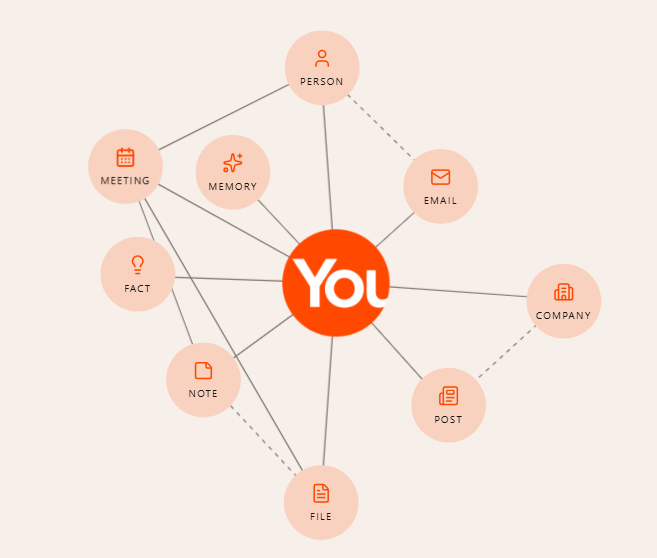
YouSpot describes itself as a “self-building second brain” for customer context. Rather than asking users to maintain every contact, activity, and note manually, it aims to assemble relationship history from connected sources and make that information accessible through conversation. The result is closer to an AI relationship assistant than a smaller edition of HubSpot CRM.
HubSpot Next is an internal incubation and R&D group at HubSpot focused on building experimental, AI-native products outside the core CRM. Its marquee project is YouSpot, a conversational, AI-native solo CRM designed specifically for one-person companies like freelancers and consultants.

What HubSpot YouSpot Means
he phrase “HubSpot YouSpot” can create confusion because YouSpot carries HubSpot branding but serves a different audience from the main customer platform. It is a HubSpot Next project associated with HubSpot co-founder and CTO Dharmesh Shah, not a replacement name for HubSpot CRM.
The official explanation of YouSpot defines it as a personal CRM for the people you know, conversations you have had, and follow-ups you intended to send. Its target user is a solo professional whose network has commercial value but who does not need—or want to administer—a team-wide revenue system.
Its center of gravity remains customer context. YouSpot is concerned with who you know, what happened between you, where an opportunity may exist, and what deserves attention next.
Why HubSpot Is Exploring a Solo CRM
Traditional CRM software was designed for organizational coordination. Sales representatives need shared accounts, managers need forecasts, marketers need lifecycle data, and service teams need a consistent customer history. Fields, stages, permissions, dashboards, and automation allow several people to work from the same records.
A solo operator faces a different problem. The same person handles prospecting, meetings, delivery, partnerships, and follow-up, so CRM administration competes with revenue-producing work. Manual records often become incomplete because every update has an immediate cost but a delayed benefit.
YouSpot’s premise is that AI can reverse that workload. It interprets existing communications and constructs enough context to answer practical questions. AI retrieval is therefore the primary interface, not an optional assistant attached to a conventional pipeline.
How the Self-Building Second Brain Works
YouSpot can connect sources including Gmail, Google Calendar, LinkedIn, X, and HubSpot. Messages reveal what was discussed, calendar events show when people met, and CRM records may contain formal customer or deal information.
The system can create searchable objects and relationships from that material. Its current YouSpot Pro plan lists contacts, companies, notes, files, multiple mailboxes, AI models, semantic search, and connected business services.
Semantic search retrieves information by meaning instead of relying only on exact words, fields, or filters. A question can therefore match relevant material even when it uses different wording from the original source.
In practice, a user could ask which contacts know someone at a target company, what was discussed before an upcoming meeting, or which conversations appear to have stalled. The system can draw together several pieces of evidence rather than forcing the user to remember which application contains the answer.
The Idea Is Not New: Obsidian and Earlier Second Brains
YouSpot did not invent the second brain, personal knowledge management, or the personal CRM. People have long used address books, spreadsheets, note systems, and dedicated relationship managers to preserve context about their networks. Tools such as Obsidian also let users build connected knowledge bases containing people, companies, meetings, projects, and follow-up notes.
Obsidian is a useful comparison because it shows the established version of the idea. It stores user-created notes as local Markdown files and connects them through links, backlinks, tags, and properties. Someone can create a note for every contact, link each person to a company, attach meeting notes, and use structured properties for the last interaction or next action.
The difference is not whether either product can become a second brain. It is who does the building.
With Obsidian, the user deliberately captures, edits, links, and maintains knowledge. Its local Markdown storage model provides portability and control, but the usefulness of the system depends on consistent input and a structure the user understands.
With YouSpot, the product aims to infer and assemble relationship context from systems where activity already occurs. The user asks questions across imported or connected information rather than manually creating every link.
The comparison reveals YouSpot’s actual innovation. The concept of externalized memory is established; the newer proposition is that AI can reduce the manual work traditionally required to build and query that memory.
YouSpot Is Not a Smaller HubSpot CRM
The main HubSpot platform and YouSpot address different operating models. HubSpot CRM is designed to become a shared system of record for a business. YouSpot is designed to become a personal context layer for one operator.
HubSpot CRM remains the appropriate choice when a business needs assigned record ownership, standardized lifecycle stages, sales pipelines, marketing automation, support tickets, permission controls, attribution, forecasting, or team reporting. Those functions are not administrative decoration. They make coordinated customer work measurable and repeatable.
YouSpot is most relevant when the primary questions are personal: Who have I spoken with? What did we discuss? Which introductions are available? What commitment might I have missed? These are relationship-memory questions rather than workflow-governance questions.
The products can overlap. A founder might keep customers, verified deal stages, consent records, and commercial commitments in HubSpot while using YouSpot to search a wider network of investors, advisers, former colleagues, and partners. This boundary matters because two systems can otherwise present conflicting versions of the same relationship.
What YouSpot Can Be Useful For
Meeting preparation is one of the clearest applications. A solo operator can retrieve previous discussions, mutual connections, company information, promised actions, and the date of the last interaction without searching several services.
Network discovery is another strong use case. Searching people, companies, communications, and public profiles by meaning may reveal an introduction path that an alphabetical contact list would miss.
Follow-up recovery is equally relevant. A personal CRM can surface unanswered questions, promised material, tentative meetings, or expressions of interest that did not progress.
YouSpot’s tool library also includes company research, LinkedIn exploration, prospect discovery, and other revenue-related applications, reinforcing its focus on commercial context rather than general note-taking.
The value depends on the source material. If meaningful relationships are documented in connected accounts, YouSpot has context to retrieve. If decisions happen mainly in unrecorded calls, private messaging services, or face-to-face conversations, any automated view will remain incomplete unless those interactions are captured elsewhere.
Data Access Changes the Evaluation
A self-building relationship system needs broad access, making permissions and data handling part of its core functionality. YouSpot’s connected-services terms say users may connect Google services, LinkedIn, X, and HubSpot through OAuth. Documented Google permissions include read-only Gmail access and the ability to read and edit calendar events, but not to send, alter, or delete email.
The same terms list providers involved in AI responses, embeddings, long-term memory, enrichment, storage, hosting, authentication, payments, analytics, and operational monitoring. They also warn that AI output may be inaccurate and that submitted input should not be treated as confidential.
This matters when an account contains client material, personal data, or information covered by contractual restrictions. Convenience does not create permission to expose third-party data. Users still need to know what is imported, which providers process it, how retention and deletion work, and whether they have authority to connect the source.
Obsidian’s local storage creates a different risk profile, not a risk-free one: local files still require backups and device security, while sync services and plugins can add external processing. YouSpot’s value depends more directly on connected cloud data and hosted AI.
Current Limitations and Product Maturity
YouSpot is still an early product. Integration depth, model behavior, pricing, availability, data controls, and product boundaries may change as HubSpot Next tests the concept.
AI retrieval also has inherent limits. A persuasive answer may be based on incomplete sources, a mistaken identity match, or an outdated interaction. Important facts such as customer status, contractual commitments, consent, and financial terms still need an authoritative record.
The product is not intended for go-to-market teams that require shared processes. Once several people need to assign work, control access, report on a pipeline, or maintain one verified customer history, the personal CRM model becomes insufficient.
YouSpot fits the point before that transition: one operator, a commercially important network, fragmented context, and too little time for manual CRM maintenance. Obsidian and earlier second-brain tools prove that external relationship memory is not a new idea; YouSpot’s bet is that an AI-first, self-building version can make that idea useful to people who would never maintain it by hand.